
In energy, stronger asset management starts with seeing risk sooner and acting on it smarter.
A line is aging. A substation needs a closer look. A solar field is underperforming. A methane concern needs answers. A wildfire season is approaching. Everyone agrees the assets matter. Everyone agrees the risks are real. But the real question is not whether you can collect more data.
It is whether your team can turn that data into action before cost, compliance pressure, or operational exposure catches up.
That is where the conversation changes.
The most effective drone consulting services in USA are not built around aircraft first. They are built around decisions. Around reliability. Around repeatability. Around knowing what to inspect, how often to inspect it, what data matters, and how that data needs to land inside existing operations.
That is why more utilities, oil and gas operators, renewable energy owners, and infrastructure teams are investing in drone consulting services for energy companies instead of simply hiring someone to fly.
Because in advanced asset management, the drone is not the strategy. It is the tool.
And yes, that distinction matters more than people think.
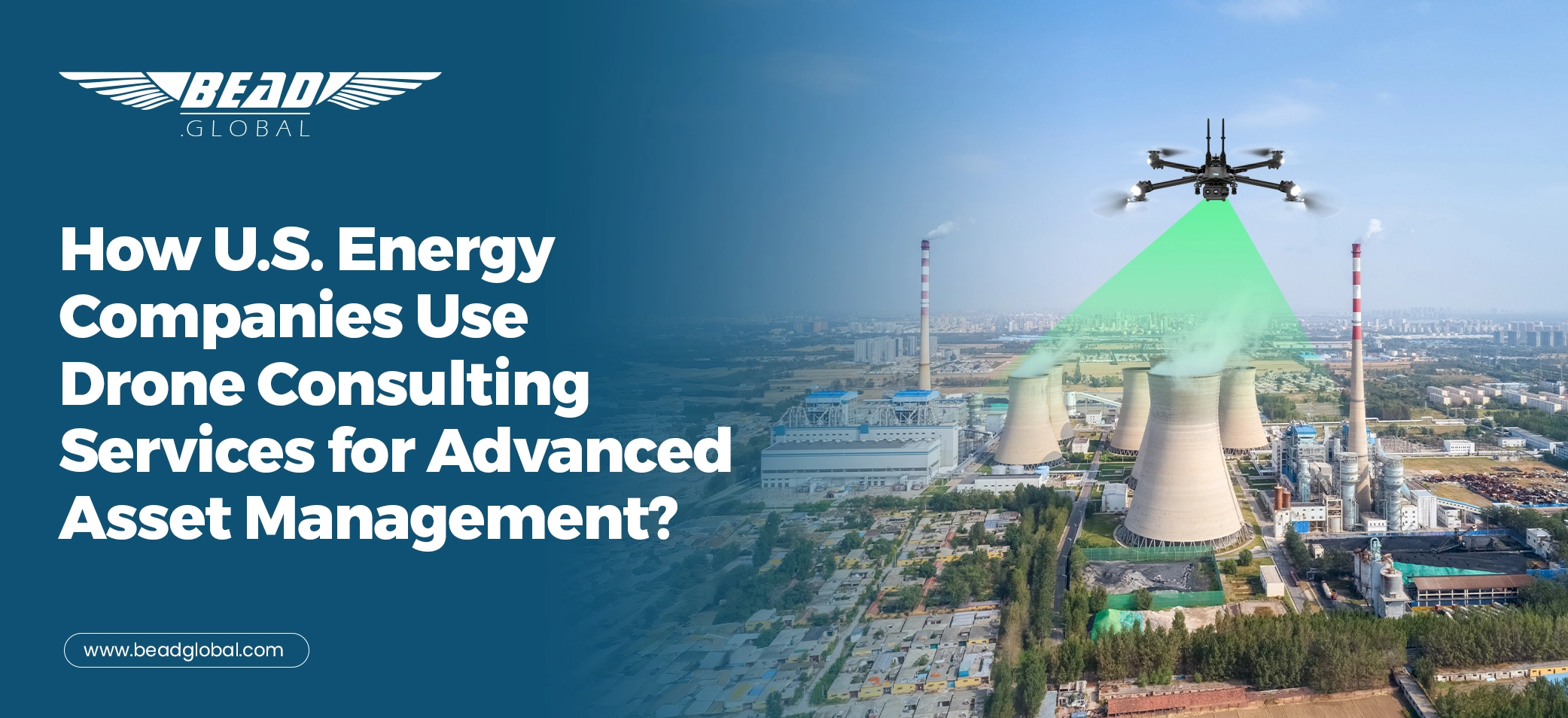
The Scale of The Job Is Already Enormous
The U.S. grid is not a small system asking for a small solution. The Department of Energy says the electric grid includes more than 9,200 generating units, more than 1 million megawatts of generating capacity, and more than 600,000 miles of transmission lines. DOE materials also describe a system with roughly 70,000 substations, 5.5 million miles of distribution lines, and 180 million power poles.
At the same time, the energy mix keeps evolving. EIA reports that renewables supplied about 23% of U.S. utility-scale electricity generation in 2024, with wind at about 11% and solar at about 5%. More asset types, more distributed infrastructure, and more performance expectations usually mean one thing: more inspection complexity.
So, when people ask why energy sector drone consulting is growing, the answer is not trendy technology.
It is operational pressure.
Energy companies are managing larger, more varied, and more scrutinized asset portfolios than ever before. They need faster condition awareness, stronger documentation, safer inspection methods, and cleaner reporting. Not eventually. Now.

What Energy Companies Actually Need Is Not “A Drone Program.
This is where BEAD Global sees many organizations get stuck.
They think the next step is buying hardware, testing a few flights, and hoping the value becomes obvious later. But advanced asset management does not reward random acts of innovation. It rewards systems.
Consulting matters because energy teams need clarity on questions like:
- Which assets should be inspected by a drone, and which should not?
- What inspection cadence matches risk, condition, and regulatory exposure?
- What data types are needed: RGB, thermal, LiDAR, methane sensing, modeling, or change detection?
- How will outputs support maintenance, engineering, vegetation, wildfire, environmental, compliance, or executive teams?
- What makes a deliverable decision-ready rather than just visually impressive?
- How will the program scale across territories, business units, or vendor networks?
That is the real work.
EPRI’s 2025 asset inspection and maintenance maturity framework makes this point clearly. It focuses on whether utilities have the people, processes, technologies, risk visibility, and decision-ready data required to support strategic objectives. It is not just about collecting inspection imagery. It is about integrating inspection and maintenance into decision-making tied to reliability, cost, risk, and safety.
That is exactly why utility drone consulting services are becoming more valuable than one-off drone flights.
Because one-off flights can give you images.
A mature consulting-led program gives you operating leverage.

What Advanced Asset Management Looks Like in Practice?
When energy companies use drone consulting well, the workflow becomes much more intentional.
A consulting-led approach usually starts by mapping assets by criticality, geography, inspection frequency, failure consequences, and stakeholder requirements. From there, the drone operation is designed to serve the business case.
That may look like:
Transmission and Distribution
Consultants help determine were drones support structure inspections, corridor reviews, vegetation intelligence, construction verification, storm response, or post-event documentation. The value is not just safer access. It is repeatable field intelligence that can be compared over time.
Substations and High-Risk Environments
EPRI notes growing utility interest in dispatchable substation drone docks capable of visible, spectral, and electromagnetic inspections of assets and vegetation. That is a signal that utilities are thinking beyond ad hoc flights and toward integrated inspection infrastructure.
Solar and Renewable Energy Assets
NREL notes that infrared imaging can support inspection during normal PV system operation, and that recent advances in machine learning and drone technology have improved the efficiency and accuracy of these inspections while reducing the need for human intervention.
Oil and Gas Monitoring
DOE and EPA selected methane monitoring and mitigation projects specifically aimed at helping operators reduce, monitor, measure, and quantify methane emissions. That tells you something important. Emissions visibility is no longer a side conversation. It is becoming part of the operating environment.
In every one of these cases, the strongest results come when the flight operation is tied to asset management outcomes from the beginning.
Not “go capture what you can.”
But “go capture what the business needs to know.”

Why Consulting Matters Even More Now?
The timing matters.
FAA policy continues moving toward more scalable drone operations. In August 2025, the FAA announced a proposed BVLOS rule intended to normalize beyond visual line of sight operations, including support for infrastructure inspection. The FAA’s 2025 Drone Integration Concept of Operations also states that its policies have supported the safe integration of over 800,000 registered drones into the national airspace system.
That is important for energy companies because the ceiling is rising.
But a rising ceiling does not create value by itself.
It simply means organizations need a smarter plan for how to use the access they are gaining.
This is where consulting earns its keep.
A good consulting partner helps an energy company answer:
- What inspections should remain pilot-operated, and what may eventually move toward more autonomous workflows?
- What data governance rules need to be in place before scale creates confusion?
- How do you standardize deliverables across multiple territories or service providers?
- How do you align inspection outputs with maintenance planning, executive dashboards, or regulatory reporting?
- How do you build a program that survives leadership changes, vendor changes, and operational growth?
Because let’s be honest.
A thousand photos and no decision path is still just expensive clutter.
Why BEAD Global’s Model Fits This Need?
At BEAD Global, we believe energy companies deserve more than a vendor who shows up with a drone and a memory card.
They deserve a partner who understands how to assess the use case, integrate the right operating model, and maximize the value of the data collected.
That is why our consulting lens is different.
We help clients think through the program before the mission. We align the workflow to the asset, the risk, the deliverable, and the people who have to act on the result. And because BEAD Global operates through a Vendor-Select Execution Model, we are able to help shape the right delivery structure rather than forcing every problem into one flight format.
Sometimes the answer is recurring utility inspections.
Sometimes it is a targeted baseline and change-detection workflow.
Sometimes it is thermal.
Sometimes it is LiDAR.
Sometimes it is methane monitoring.
Sometimes it is not a drone at all.
That is what real consulting should do.
It should protect the mission from the wrong tool.

A Few Pro Tips for Energy Teams Considering Drone Consulting?
Start with one operationally meaningful workflow.
Pick a use case tied to real risk or recurring cost, such as line inspection, solar thermal review, methane monitoring, vegetation risk documentation, or storm-response baselining.
Define what “decision-ready” means before the first mission.
If your maintenance, engineering, compliance, and executive teams all need different outputs, decide that upfront.
Build around repeatability, not novelty.
The best programs do not win because the drone is impressive. They win because the workflow is repeatable, auditable, and useful.
Make data governance part of the design.
Naming conventions, metadata, storage and retention rules, QA/QC, and reporting pathways should not be afterthoughts.
Use consulting to bridge departments.
One of the biggest wins in drone consulting services for energy companies is helping operations, safety, engineering, environmental, and leadership teams work from the same truth set.
The Real Advantage Is Not Faster Flying
It’s better asset intelligence.
That’s the shift.
Energy companies are not adopting drones because they want cooler inspections. They are adopting consulting-led drone workflows because they need more reliable visibility across assets that are growing in complexity, exposure, and importance.
The future of the energy sector drone consulting belongs to the organizations that can connect field capture to business action.
That means safer inspections.
Smarter maintenance.
Better reporting.
Stronger proof.
And a clearer path from observation to decision.
For U.S. energy companies trying to modernize advanced asset management, that is not a nice-to-have.
That is the work.
Are YOU ready?
If your team is exploring utility drone consulting services or looking for a stronger approach to drone consulting services in USA for energy infrastructure, BEAD Global can help you assess the opportunity, design the right workflow, and build a program that actually supports asset management, not just image collection.
Because in energy, better visibility is good.
But decision-ready visibility is where the real value starts.